Tag: bashar

  • Living Life on Easy Mode – Follow your Excitement

    Living Life on Easy Mode – Follow your Excitement

    If you’d rather listen to this post you can do so here.

    Life is complicated. It can be overwhelming to make decisions with incomplete information, such as how best to spend our time, which career path to choose, how to manage our health, and how best to strike the balance between productivity and rest.

    What if there was an easy mode, where someone would tell you exactly what you should be doing during every minute of the day? What if this person had access to complete information and always chose the action that maximized your benefit? Sounds like the plot of some near-future science fiction book, right? The spiritual teacher, Bashar claims that this is how our reality works if you know how to play the game. When I first heard this, I got excited because this is a testable hypothesis. I and many others have been running this experiment, and I can testify that this does in fact seem to be how the universe works. This all-knowing advisor is your higher self or higher mind—some component of your soul that lives beyond space and time and sees a broader perspective of your life path. It communicates the right actions to take through intuition and the feeling of excitement. If you follow these hints, you will get exactly what you need at the exact time you need it.

    Let’s get a better picture of how this could play out. You wake up on a Saturday morning and feel drawn to read a book. You read happily until the thought occurs to you, “I guess I should put the laundry in”. You feel good about having been productive and become motivated to do the dishes and pick up a few things that are scattered around your house. Everything is now clean and taken care of and you feel satisfied. You walk over to the window because something outside catches your eye. When you’re there you think, “It’s a nice day! I’ll go for a walk”. Before you leave, you load the laundry in the dryer. Outside, you start down the route you usually take but then something attracts you to a street on the left you normally don’t go down. You decide to go, and on that street, you run into a friend you’ve been meaning to reach out to. They invite you to go swimming in the river. That sounds great, so you agree. You invite them back to your house so you can change into your bathing suit. When you arrive, your house is spotless and ready for company. Your bathing suit has just finished drying in the dryer. You change, and as you’re walking to the river, your friend mentions a problem they’re working through. Coincidentally, you have the answer they’re looking for because you were just reading about it in your book this morning.

    Bashar’s formula for how to achieve this state is as follows. 1) Act on your excitement in the moment. This could be working on big goals, or it could be as simple as deciding which direction to walk or which stretch to do next. 2) Do this to the best of your ability for as long as you feel motivated to do so. You were excited to read until you felt like you wanted to do the laundry. 3) Act on your excitement with no insistence on what you think the outcome should be. You don’t really know what the optimal outcome will look like so you have to remain open to whatever comes your way. In the example above, if you countered the thought about walking down that side street with the thought “well I never go that way, so why should I go now,” you would miss out on the opportunity to see your friend. 4) Choose to remain in a positive state no matter the outcome. This is critical, as we will see in a minute. 5) Constantly investigate your belief systems and release/replace fear-based beliefs with those that are in alignment with who you prefer to be. Pay attention to what motivates your thoughts. Thoughts like, I haven’t painted in a while, so I guess I need to paint or else my skills will waver, are fear based rather than excitement driven. When you are meant to paint again you will be excited to, rather than afraid of the consequences of not painting right now.

    It’s worth digging into these last three steps. You’ll notice that in my river example everything works out in a positive way for all, but rules three to five of the formula imply that acting on your excitement may not result in the outcome you hope for. It is critical not to ignore this. Following your excitement sometimes brings about objectively negative outcomes, but if it does, this is because the present time is the optimal time for you to deal with the negative outcome. Your higher self is bringing something to your attention that you need to deal with in this moment.

    For example, yesterday I felt compelled to get tickets to a baseball game. I looked at the list of available dates and realized the one that was most exciting to me was later that same night. I asked my wife if I could go. She hesitated because that would mean she had to take care of our two-year-old son alone all night. She said yes and I bought the tickets, but I was immediately hit with guilt. I felt like I was a selfish, terrible person. How could I abandon my family to do something that only I enjoy? Parents of young children will be extremely familiar with this situation. I hated how I felt, but my higher self was directing me to encounter this difficulty at that time because it was the best time to deal with some issues I’ve struggled with for most of my life—the fear of being selfish and the fear of asking for what I truly want when it’s not what others want.

    When you follow your excitement and encounter an outcome you don’t prefer, which elicits a strong negative emotion, Bashar suggests you ask the following questions. “What would I have to believe is true about myself to experience this emotion?” and “What am I afraid will happen if I follow this excitement?” Asking these questions allows you to find the negative beliefs that underpin the emotions, and once these are found, you will see that they are nonsensical. In this case, I would have to believe that it’s not okay to occasionally do things for myself. This is nonsense. I am an involved father, and I love my family. Everyone needs a break sometimes to pursue the things they find truly exciting. If it were my wife asking to go do something she loved, I’d have no problem giving her that gift, just as she gave it to me. Like many of us, I have a harder time receiving gifts than giving them. To answer the question, “What am I afraid will happen,” I was afraid my wife would believe I only think about myself and that she wouldn’t love me. I was afraid that taking care of myself in this way would make me a bad person. All these beliefs are nonsense, and going through this investigative exercise made them appear so. I went to the game and had an amazing time.

    As I mentioned, I’ve been using the formula in my life. I applied it while writing this blog post, and it helped in several ways. First, I felt genuinely excited to be working on the post every time I sat down to write. When that excitement faded, I followed it elsewhere. Life is much easier when you’re engaged in an activity you’re excited about instead of forcing your way through it. Second, it calmed my mind to trust that the post would be completed when it was meant to be and would contain exactly what it was meant to contain. The formula helped me bypass the inner critic that constantly evaluates how things are going and whether a task is done “well enough.” I relied on the belief that my higher self would guide me to finish it at the right time, with the right content. Third, it took some time to settle on an image to go along with the post, but again I trusted that the right one would appear when it was meant to. I can’t explain why I like the one I chose—but I do—and the anxiety I might normally have felt about the decision was completely bypassed.

    If these ideas resonated with you, Bashar covers a lot of the nuances that might come up in different situations. I highly recommend checking his content out. If you enjoy this post, check out my other blog posts here and my YouTube channel, where I post guided meditations and audio versions of my blog posts.
  • Belief Engines: The Permission Slip Ritual

    Belief Engines: The Permission Slip Ritual

    In my other blog posts I’ve mentioned the spiritual teacher, Bashar. Today I want to focus on one of his concepts I love, the permission slip. A permission slip is any ritual or behavior that helps you to accomplish something that you want to accomplish. That statement sounds very general because it is! It’s applicable to so many areas of life. You are already familiar with permission slips, so once you learn about them, you’ll begin to see them everywhere. Apart from using them every day in non-spiritual contexts, they are extremely powerful tools for manifestation. I’d like to emphasize a few points about them that I haven’t encountered elsewhere.

    A permission slip is a ritual that becomes an excuse for your mind to believe in a desired belief. To simplify things slightly, Bashar claims that when you truly believe in something, you manifest it into reality, so long as it’s something meant for you to experience in this life. I’ve talked about manifestation in previous blog posts so I won’t go into detail about its power here, but I doubt there’s anyone alive who wouldn’t like to manifest a few things into their life. In this post, I’ll describe how I created one myself and then walk through a few everyday examples to help get you brainstorming how you can design your own to start using right away.

    In spiritual circles, crystals and gems can be used for healing and to elicit certain emotional states, as well as other things. For instance, clear quartz is used for clarity, amplification, and energy alignment. Celestite is used to bring peace, connect with higher realms, and calm the nervous system. One apparent fact about crystals is they occasionally need to be recharged or cleansed for them to work optimally since they absorb energy from the environment. I actually wonder whether this is universally true or if it’s a belief that manifests reality, but that’s a topic for another day.  

    It is believed that you can recharge crystals by various methods like placing them outside under a full moon, under direct sunlight, by cleaning them with fresh or salt water, by burning incense, by using sound such as tuning forks, etc. Since these methods are well established, they are not often thought of as what they are—permission slips. The underlying truth of what is happening when you recharge a crystal or gem in these ways is that you 1) perform an action that you believe will have a given outcome, and 2) that belief manifests the believed effect. Permission slip.

    For many people, the above rituals are sufficient, but none of them really resonated with me. I like the idea of charging my crystals in the moonlight because there’s a magical quality to both nighttime and moonlight, but I don’t want to have to check the moon cycle or place my gems outside overnight. I created my own permission slip for recharging crystals:

    1. I place a gem in my face-up palm and take a few deep breaths.
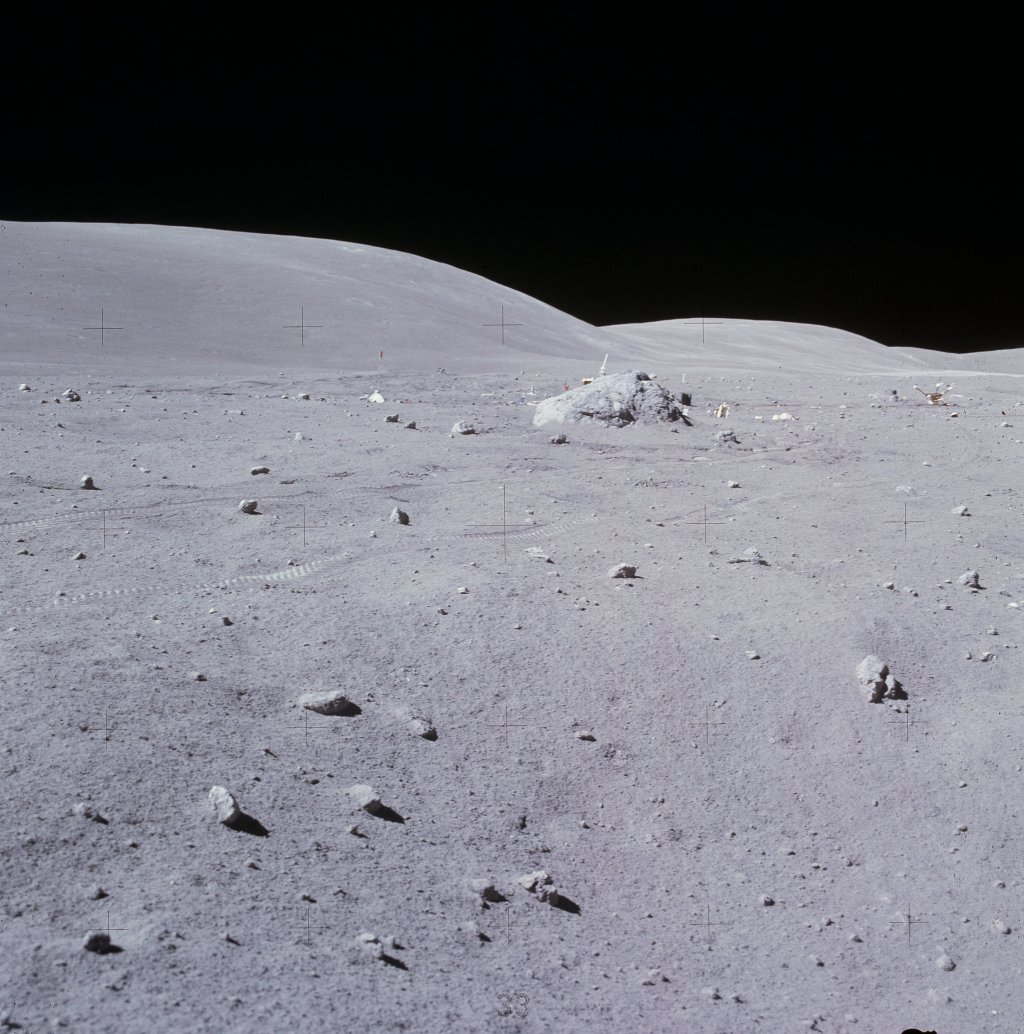
    2. I visualize the surface of my palm becoming the surface of the moon. There is a beautiful view of both the Sun and the Earth.
    3. I feel the weight of the gem causing it to sink slightly into the lunar dust.
    4. I feel the dust on my hands. I smell this dust as it floats up to my nose.
    5. I visualize the sunlight striking the crystal and heating it up (Space, in sunlight near the Earth, is quite hot. The surface temperature of the moon can reach 250°F).
    6. I imagine a crackling sound as the internal structure of the gem is reenergized.
    7. I think “By placing this gem here I realign it with its highest frequency. I appreciate and thank the sun, the earth, and the moon.”
    8. Finally, I return the gem to my palm here on Earth.

    For me, this exercise is a lot more interesting and visceral than placing the gems in the moonlight here on Earth, but that is just what resonates with me. You can use the following formula any time you find something that you want to accomplish where you don’t have a method or the methods available don’t resonate with you.

    1. Decide which outcome you want.
    2. Visualize in detail what should happen during the ritual.
    3. Acknowledge that your ritual accomplishes what you intended.
    4. Say thank you.

    Adjust anything you’d like, even these steps. You don’t just have to visualize whatever you want happening. You could also perform actions such as burning incense, lighting a candle, doing jumping jacks—whatever you like. I don’t have proof, but it feels to me like making it your own makes it work better than just taking someone else’s ritual. Your ritual doesn’t have to stay the same for all time either. Change things as you feel inspired and you will keep it fresh.

    Everyday Permission

    As I mentioned before, the non-spiritual world is filled with permission slips or rituals designed to make you believe in something—hence manifest—but they are not often identified as such. Once you identify a permission slip you have the opportunity to change it and “find what feels good”, to quote yoga teacher, Adriene Mishler.

    When I went back to school in my 20s, I became very interested in meta-learning, the study of learning how best to learn. I found that the book “How to Become a Straight-A Student” by Cal Newport had several permission slips designed to get you into a focused, studying mentality. Some examples included studying for an exam in the room you would take it in, having a dedicated light on your desk that you only turned on when you needed to focus, only studying at specific times of the day, carving out daily blocks of time you would be unreachable so you could accomplish focused studying, and having snacks and water available for consumption at specific times to keep yourself fueled and focused. These don’t require visualization like my lunar surface crystal recharge ritual, but they are permission slips, nonetheless. You give your mind permission to believe you are focused because your focus lamp is on, and you manifest focus. This is a good time to mention that you don’t technically need a permission slip to believe something you want to manifest, but it’s a simple way to make the human mind believe in something, and belief is the action that manifests things.

    The world of sports is also filled with rituals that athletes use to signal that it’s time to perform. Some of these include putting gear on in a specific order, wearing specific things like jewelry or underwear, blessing oneself before taking an at-bat, bouncing a tennis ball a specific number of times before serving, etc. The full list is probably longer than the number of athletes on Earth.

    The painter, Ian Roberts, talks about a design professor who taught at the Rhode Island School of Design and MIT whom I only know by the name of Daniel. Daniel does not refer to a studio as a place you can walk into, but rather a verb. He created a permission slip that says, any time his attention is drawn to something that sparks his artistic attention, he purposefully enters a mindset of awe, connection, and play that enables him to achieve his artistic goals. In my own words, his ritual would be something like:

    1. Notice something that you are attracted to, artistically.
    2. Remember this means it is now time to “enter studio”.
    3. Embody the qualities you’ve purposefully developed in your artistic endeavors, such as playful curiosity, mindfulness—in the sense of checking in with yourself to understand what it is that you are feeling as you see this object or scene—perseverance, patience, focused attention, etc.

    I find the permission slip to be extremely freeing. Before I encountered Bashar’s idea, I tended to strictly adhere to rituals for fear that they wouldn’t work if I deviated. Now I understand that the goal is to establish belief. For me it’s much easier to permit myself to believe if I’ve created the ritual to my own liking.

    One final note on belief. I don’t literally believe that my gems were teleported to the moon. I believe that they are recharged because of my ritual. When I place them there in my mind’s eye—when I see the sunlight and feel the dust, hear the cracking—something unexplainable happens. I just know they’re recharged.